Abstract
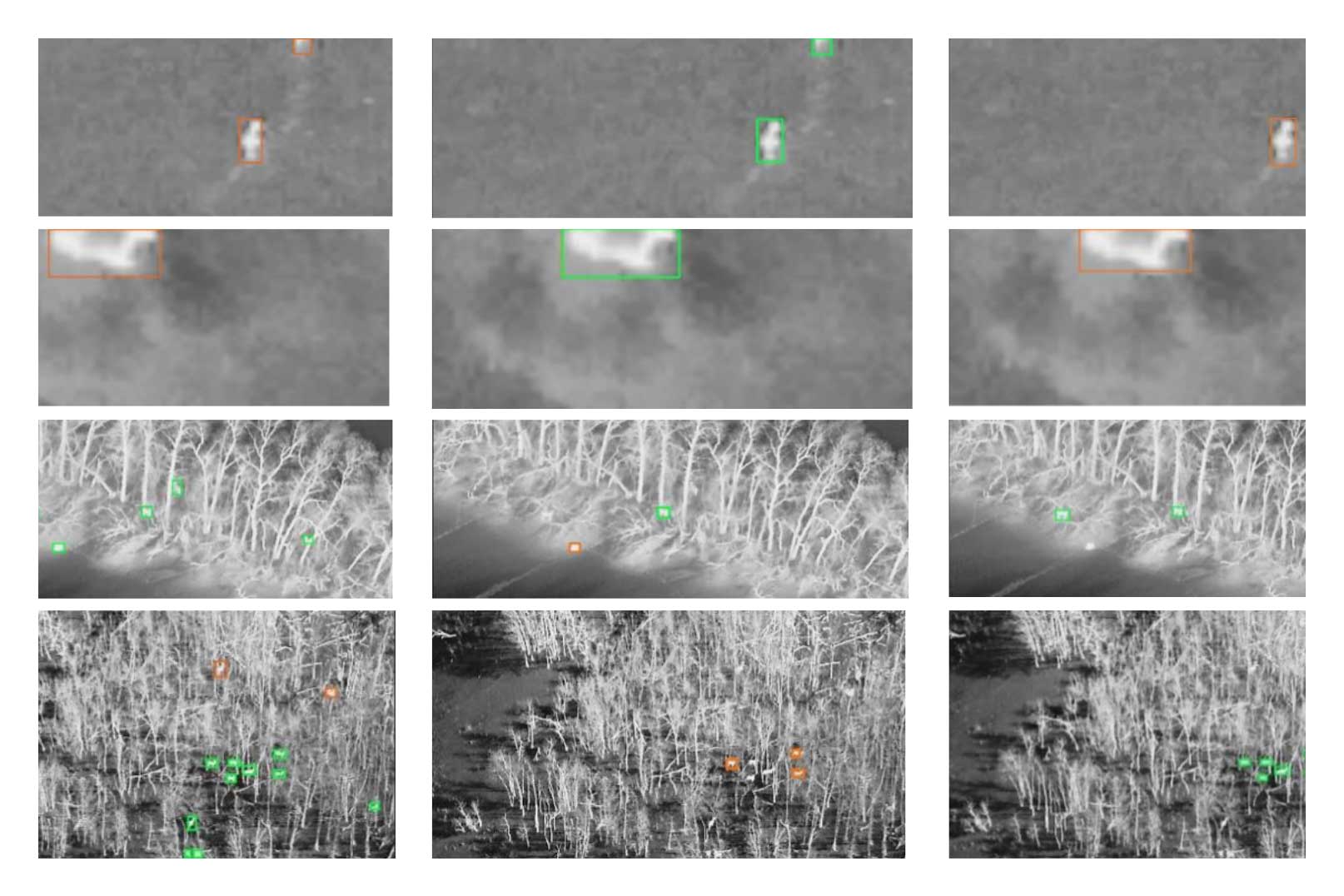
Unmanned aerial vehicles (UAVs) equipped with thermal infrared sensors offer a promising approach for surveying ungulates in boreal environments. Although recent advances in deep learning enable automated detection from aerial imagery, detecting and classifying visually similar species, such as moose (Alces alces) and deer (Odocoileus virginianus / O. hemionus), in low-resolution thermal imagery remains challenging and largely unexplored. This study addresses this gap by evaluating a convolutional detector (YOLOv11) and a transformer-based detector (LT-DETR; RT-DETRv2 with a DINOv3-pretrained backbone) using thermal UAV imagery collected across multiple survey dates in southern Manitoba, Canada. We assembled a challenging dataset of 4787 images containing 9243 annotated instances (2377 moose; 6866 deer), characterized by strong variation in object scale and survey conditions. A cross-survey evaluation protocol was used to assess generalization under realistic operational settings. LT-DETR showed stronger performance overall, achieving 29% higher precision (0.75 vs. 0.58), 17% higher recall (0.62 vs. 0.53), and 22% higher mAP50 (0.72 vs. 0.59) than YOLOv11 on average (all differences statistically significant, α = 0.05). This advantage was consistent across object sizes, with mAP50 improvements of 24, 19, and 10% for small, medium, and large objects on average, respectively (all differences significant, α = 0.05). An ablation study demonstrated the benefit of DINOv3 and COCO pretraining for both convergence speed and detection accuracy, with the largest gains when the backbone and detection head were jointly pretrained. Additionally, a comparison of YOLOv11 variants revealed that performance did not scale with parameter count, with the X-Large variant performing comparably to Small. Detection performance varied by species: moose had higher detection rates (recall), while deer were frequently missed and undercounted. Moose detection improved with increasing object size, whereas deer showed the opposite trend, reflecting the large class imbalance in object scale between the two species. Deer were also more prone to confusion with background objects, and inter-species misclassification remained common. Overall, the results suggest the suitability of transformer-based architectures for low-resolution thermal imagery due to their stronger global contextual modeling, as well as the strong representational capacity of modern pretraining. However, performance remained modest overall and variable across surveys, highlighting persistent challenges in cross-survey generalization and fine-grained species classification in thermal UAV-based wildlife detection, motivating future work and discussion on operational use.
Read the full paper here (open access)
Citation
Hiroto Goto, Nicholas C. Coops, Gordon Stenhouse, Kwang Moo Yi, Leonard Hambrecht, Kirsten Solmundson, Automated detection of moose and deer in thermal imagery using unmanned aerial vehicles and deep learning, Ecological Informatics, Volume 99, 2026. https://doi.org/10.1016/j.ecoinf.2026.104068.