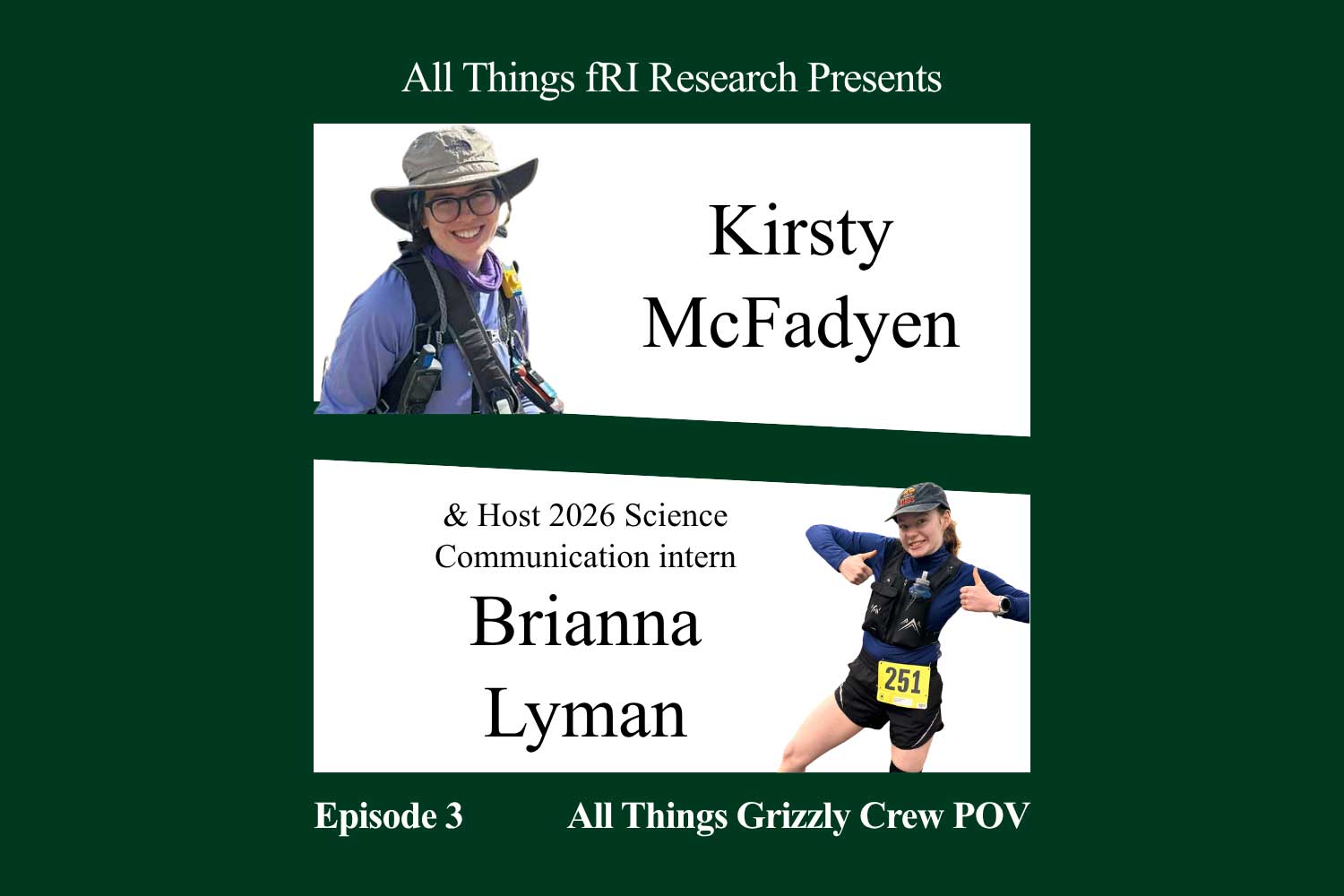
Kirsty McFayden shares her experiences as a Grizzly Bear Biologist on a close-knit crew. Her wild and descriptive stories about fieldwork and trail cameras show how rewarding fieldwork can be.
Transcript
Brianna Lyman:
Have you ever wondered what life could be like doing field work? Well, then you’re in luck. Because in today’s final episode of All Things fRI Research, we are chatting with Grizzly Bear Crew biologist Kirsty McFadyen. Kirsty first joined free research as a field tech back in the summer of 2024, with the ongoing grizzly bear monitoring program. That summer, she was offered an extension to stay into the winter, reviewing trail cam footage, witnessing wildlife on the trail cams, as well as being part of a close knit team, quickly became what Kirsty looks forward to most about her work at fRI research.
Kirsty McFadyen:
I think working in our team is what gets me the most excited. We have just a great team, we have the best field technicians and just working with folks that are so passionate just keeps me excited every day. I’d say another part for me would be anything with the trail cameras. You just feel so connected to the animals that visit our sites and it’s just awesome to see, like your friends on the trail cameras and then see, like, these beautiful animals show up and yeah, you just feel like you’re all part of the same thing.
Brianna Lyman:
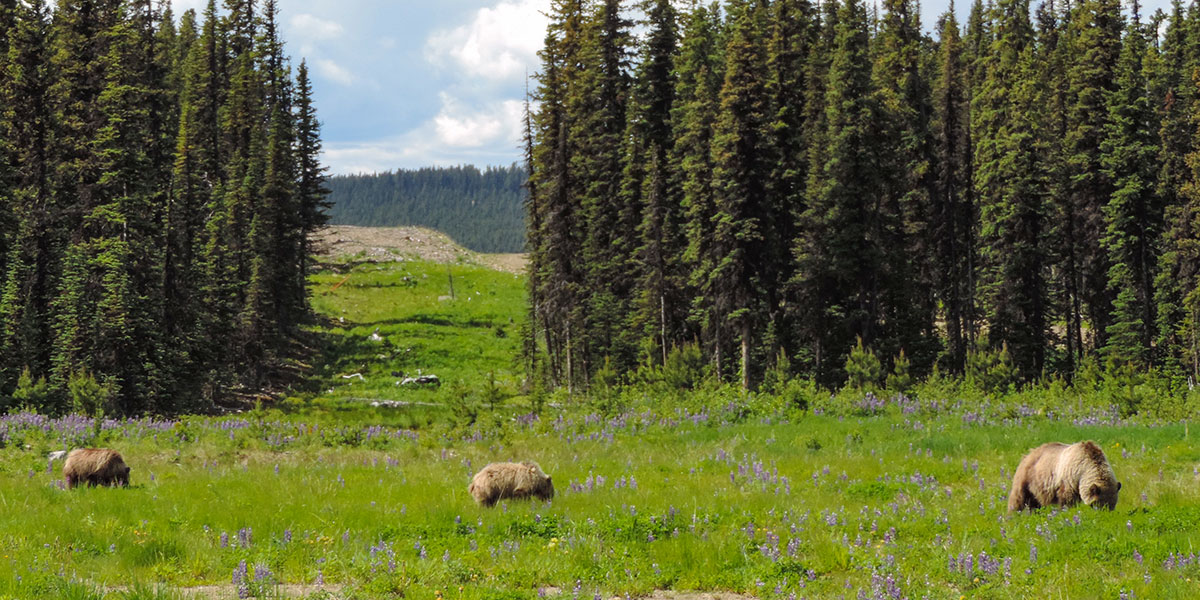
Trail cams allow the grizzly bear crew an up close and personal look at wildlife they usually would not encounter.
Kirsty McFadyen:
Some of my favorite things to see on the trail cameras are like mama bears with cubs, and you just see them interacting with their offspring. You see how these cubs can be such menaces at our site. You know, they’re running around causing trouble. And like, that sort of new appreciation of these animals is like really something that is, like, so unique to this job because you do go through so many images to get to see that.
Brianna Lyman:
Reviewing trail cam footage is a crucial component of the important office work that follows the field work.
Kirsty McFadyen:
The office work each year starts with us going through the hair samples, so we go through all of the hair samples, comparing what we’ve entered into the data with the physical envelopes, and making sure that everything matches, that there aren’t any errors. The next step is that we sort our samples, so we sort them into grizzly bear samples, unknown bear samples, and black bear samples.
And that’s super helpful because obviously we are a grizzly bear monitoring project. We want to prioritize analyzing the grizzly bear samples. And then we move into the trail camera image processing, which is just so much fun. With that, we use the trail cameras first to select samples so we can see with the trail cameras, like where bears will enter the site. And so we can be more confident in some samples that it will match an unique bear.
Brianna Lyman:
Trail cams are especially useful for selecting hair samples, as one cannot simply determine a grizzly bear’s hair from black bear hair from color alone.
Kirsty McFadyen:
And it’s something that we cover, like the first week of training is not to trust the color of the hair. So in our area and I guess like black bears in general, they can come in a lot of different colors. And so we have black bears that are blond, black bears that are cinnamon colored. We’ve had black bears that almost have like a kind of Mohawk coloration, which is super cool.
Brianna Lyman:
The Grizzly Bear Crew also uses trail cams to answer questions about bear behavior.
Kirsty McFadyen:
So they’re very useful for matching bears to samples. But we’re also going to be able to answer a lot of questions like we have tested a lot of different attractants. So attractants like cows blood, but then also commercially available attractants like we have like this berry scent, molasses scent, just to give a couple more examples. And so we are interested to see if behaviors, bear behaviors change sites like depending on the bait that’s there.
And then also looking at black bear versus grizzlies in terms of like which scents their most attracted to. Because for us like we have to wade through a lot of black bear samples. And we would really like to move to methods where we’re maximizing our grizzly bears and minimizing the black bears that are attracted to our sites.
Brianna Lyman:
To collect hair samples and footage, the crew needs to first set up sites that draw in grizzly bears using those attractants like cows blood.
Kirsty McFadyen:
So at the start of the season, we actually filter our cows blood. And this is like a very fun kind of bonding for us as a team. So last year, we ended up filtering 900 liters of cows blood. And the reason that we have to filter is because cows blood coagulates really quickly when it’s exposed to oxygen. And so it gives it like quite a chunky consistency.
And so what we do is we break this kind of these chunks up with like a blender attachment on a drill. And then we strain the blood so that we only have liquid left. And so it’s quite a funny task to do because we’re all dressed up in this like yellow rain gear. You know, we’ve got masks on, we got our safety glasses on, and we just go and we process all this blood.
And the reason that we do that is because we want to use the liquid as like a scent attractant. We don’t want to put out any chunky blood, because we don’t want there to be anything that the bears can eat or get territorial about at our sites.
Brianna Lyman:
While the grizzly bear crew wants to use scents to attract the bears, that doesn’t mean they want to encounter them.
Kirsty McFadyen:
Really, what we focus on is avoiding that encounter. And so when we’re in the bush, we’re super loud. You know, some of us will sing songs. We all have different bear calls that we do. We do bear calls that are themed. So like, I’ll shout a name of like a pasta or something. And then I want my, my field partner to respond with a different one, for example.
So that’s like a silly game that we play, but it’s just like to make the most noise. And that really does minimize our bear encounters.
Brianna Lyman:
Despite these precautions, special moments still occur.
Kirsty McFadyen:
I feel like one of the standout days, just in the sense that it was so unusual was a day I had last summer with Kieran, where we pulled up to our first site of the day and we’re chatting about the site, about to get out the truck and as we’re about to get out, Kieran’s like there’s a bear, right behind us!
And so we look and there was this young grizzly, definitely a juvenile. Just kind of like pacing the road behind us. As soon as he kind of, like, noticed that we were looking at him, he ran off into the bush. But it was just so neat to see him and see him, like, so close to the site. Because the bear was so close to the site, we didn’t end up going into that one.
And so we decided to then drive to a new site, did that one as normal. But then the third site of the day, we pull up and I hop out of the truck, and I just had this funny feeling, like the hairs on the back of my neck stood up and I turn around and there’s a grizzly lying in the ditch just looking at me.
And it was so strange because I never saw the bear. But like, I guess my body knew it was there somehow. And so as she sees that I’m looking at her, she like, hops up and backs away and me and Kieran like, hop back in the truck. But it was just so interesting because we never really encounter grizzlies, but that day we encountered two like at the the point where we park our trucks. And so it was so special to get to see these bears and they behaved so well. You know, as soon as they saw as they, they went away. But yeah, it was, it was such a special day to, to see them both.
Brianna Lyman:
Fieldwork is certainly always an adventure. And this past summer they added sites only accessible by helicopter to their research.
Kirsty McFadyen:
This summer was the first time I had ever done heli fieldwork, and so I didn’t really know what to expect. I had such a great time, especially during the setup shift. Like just getting to see the landscape from at this new height is just so epic. Then we had to carry like a lot of the bait and the barbed wire, like in a cage off the side of the helicopter.
We would land and then set up the sites. And then throughout the summer, we went back every two weeks to visit the sites. And that was so cool, because what we were doing then, it was almost Mission Impossible style where we would land. The two of us would hop out while the heli was still running. We go to site, see if there was any hair there, and if there wasn’t any hair at the site, we would keep running to get back into the helicopter.
And then if there was hair, we would like radio them to like shut down, shut down, and then we would like take the time to collect the samples. And so it meant that we were often like being pretty efficient out in the field, which was a lot of fun out there, you know, running from site.
Brianna Lyman:
Having spent the summer performing Mission Impossible levels of athleticism, Kirsty is extra excited about competing in this year’s Fieldtech Olympics.
Kirsty McFadyen:
Something I’m looking forward to is we have the Fieldtech Olympics next week, so it’s like this whole day where we get to hang out with each other, but there’s all these events and so we have events like Toe Strap Tug of War where we’ll have techs on each side of it competing, you know, like a classic tug of war.
We have events where there are things hidden in the woods, and they have to use GPS to go find them. You know, like we have all these different kind of fun events with the Grizzly Bear team last year, people had to look at a hair sample and guess the precise number of hairs very quickly. That was a lot of fun.
And then we also last year had like a mix of our different bait, like all in one container. So people had to smell that, figure out like what kind of mix it was between like blood or molasses or berries or anise, like all that sort of stuff. So yeah, it’s just a day where we get to compete.
People get scored like points in each event, and then at the end of the day, yeah, like we award like gold, silver and bronze. And it’s just a lot of fun and a great way to wrap up the summer.
Brianna Lyman:
And I think this conversation has been a great way to wrap up All Things fRI Research. If you are interested in more Field Crew stories, check out our blogs, many of which are written by the fieldtechs and biologists themselves. We are thankful for grizzly bear biologist Kirsty McFadyen for sharing so many exciting adventures and memories about her fieldwork experience with us today, and we are thankful for you for tuning in and listening.
This mini series was so much fun to make and we hope you learned something new. For one last time, this was your host summer 2026 Science Communication intern, Brianna Lyman. Signing off.